Advanced Filtering And Metrics
Advanced filtering and metrics help users keep discovery aligned with a review scope while still seeing why a paper was surfaced.
Closed-world filtering rejects out-of-scope discoveries before delivery, while metrics are derived from the accepted corpus and recorded edges.
Closed-World Filtering
Closed-world mode imports an allowed corpus from a BibTeX universe file. CiteTraverse can then reject discoveries that do not match the configured world rules instead of delivering them into a screening box.
Closed-world rejections are recorded in discovery provenance with a rejection reason. The imported universe is authoritative only for the closed-world corpus and is not used to carry user annotations.
Venue Matching
Venue matching uses a configurable similarity threshold. This helps normalize provider venue strings that differ in casing, punctuation, or abbreviation while still keeping the accepted universe explicit.
Coverage Metrics
Known corpus citations and known references in corpus are derived from recorded citation edges. Unknown zero values stay blank until the relevant direction has been explored. Once that direction is explored, zero renders as a real zero.
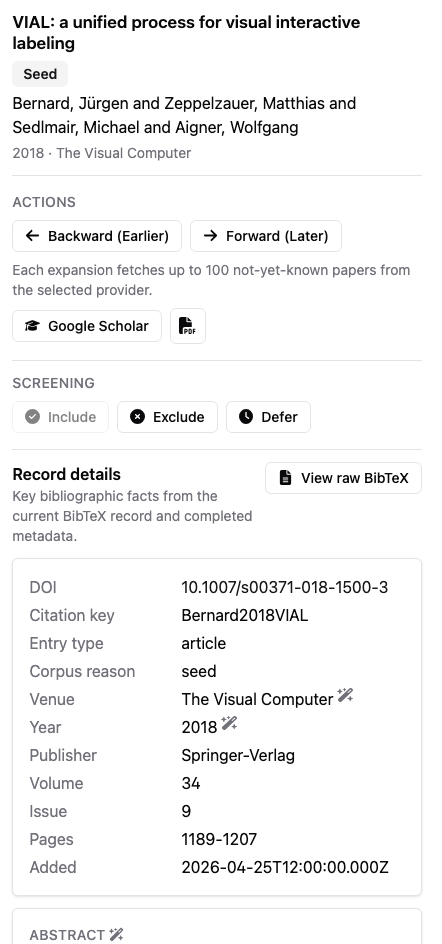
Coverage metrics distinguish unexplored relationships from explored directions that found no known neighbors.
Ranking Signals
Provider citation counts, known corpus neighbors, tags, boxes, and completion provenance can all help triage a paper. CiteTraverse keeps these signals attached to local project state so users can sort, inspect, and explain screening choices later.